.post-labels { display: none; }
Showing posts with label education. Show all posts

Wednesday, July 19, 2017

school ties

'every child is an artist.  the problem is how to remain an artist once [they] grow up'  - Picasso


*two books related to this topic...and that I highly recommend reading are The Global Achievement Gap by Wagner, and Home Grown: adventures in parenting off the beaten path, unschooling, and reconnecting with the natural world by Hewitt.

Also, check out this blog on Unschooling by Leo Babauta


As Matilda grows closer to school aged, I find myself thinking about her education more and more.  She's 4 years old now, and won't be old enough for kindergarten until the Fall of 2018.  So there is some time...but none like the present to consider options.  I honestly haven't made any conclusions about how I feel in regards to kindergarten and school yet.  But I have read a bunch, spoke to some others about it, and think on it often.  Hopefully, writing on the topic will allow me to explore it more deeply, and help define what I truly believe in.  


step back
While you may think I'm speaking of a Steph Curry 'step back' 3 pointer, I'm talking more about what I believe all of us 'citizens' need to practice before thinking about education.  It's a term that I'll use to describe a pausing, stepping out of the box, and the employment of a wide and general perspective.  You see, I never questioned school really.  I'm not sure my parents did either.  Maybe your parents didn't.  It's just been accepted over time that school is where you go starting at age 5 and ending at age 18.  It's what everyone does.  We've done it for a long time, and now you're going to do it.  But what does that allow our children?  What does it provide them?  How does it challenge them?  How is it tailored for them?  What will it prepare them for?  And how will we determine their success within this institution?  


It is pretty obvious to me that a student that attends 180 days of school (let's say a first grader), will know more facts and things than a child that doesn't go to school for that 180 days.  The schooled student will test better, follow rules quicker, and be better prepared to take in the 2nd grade curriculum.  They will be 'ahead of the curve' compared to the unschooled child.  'Stepping back' though...is saying 'who cares' to all of that.  It's saying, standardized tests are not what define my child.  It's recognizing that rules can be bent in life outside of school...there is always a loophole...and questioning everything is very beneficial.  It's submitting to the rat race of parent's claiming high percentiles of where their child sits, admitting that the curve that we're all trying to get ahead of is a slippery slope that doesn't matter as much as we're drilled to believe.  Stepping back is believing that it's ok that my child doesn't ride a bike as well as other 4 year olds.  It's ok if my child's reading level isn't where the common core says it should be.  I understand it's difficult to be ok with that, especially considering societal pressure.  But...we don't need to constantly compare each to another...and rank accordingly.  We all contain multitudes.  These microcosms and measurements are small pieces of our entire selves.  


math/statistics
6 hours per school day (approx) multiplied by 180 school days = 1080 hours per school year.  

12 school years + kindergarten = 13 school years.

13 school years x 1080 hours = 14,040 hours of total schooling through completion.


Is it too much?  Is it enough?  Are the hours used most effectively?


The average American 15 year old spends about 5 hours per week doing homework...and since students with a more advantaged socio-economic status tend to do more homework than less fortunate students, 'homework helps perpetuate existing inequalities in education', says the PISA (Programme for International Student Assessment) researchers. 

According to the Pew Research Center, the United States ranks '38th out of 71 countries in math...24th in science...24th in reading'.  

While there have been some very small gains since the 1990's, standardized test scores in the US have gone down since 2013.  


How are our schools failing us?  How are they preparing our children for the unpredictable, ever changing future?  Do test scores matter?  Do world rankings matter?  How are our children allowed to fail, and encouraged to try again...a different way? 


This TED talk is one of the most watched ever.  It asks the question, 'do schools kill creativity'?  And I highly recommend it! ...the video...not killing creativity.


How kind is kindergarten?
Recent NH news has described how full day kindergarten will finally be funded here, as it passed through the NH legislature.  

Having discussions with many parents about this, I've heard a common thread...and that is that the schedule of full-day kindergarten will allow parents to send their kids away without having to pick up or drop off midday.  So basically, it's the logistics that people are most happy about.  This is just what I've heard the most...not the entire story.  

I've also heard a bit of 'my child will be more ready for 1st grade, which will then lead to future success'.  This argument is somewhat obvious to me again...but another area in which I use the step back approach.  Of course, any student that goes through the routine of a full day school schedule will be ahead of one that doesn't.  They will test better, follow rules quicker, possess a deeper understanding of how a school day functions, sit at a higher reading and math level, etc. etc. However, the 'leading to future success' part has been proven wrong.  The intellectual and social/emotional gains from kindergarten are found up to a 3rd or 4th grade level.  After that they drop off.  So if we step back and consider what the real pros and cons of full day kindergarten are, there is more of a story that I need to be told.  Some questions I have about it are:

How much 'free play time' will children have?  What is the curriculum, and where I can I find it?  What arts will be part of the school day?  Is funding this thing with Keno (a lottery game that I believe is currently illegal in NH) a wise decision...sustainable...respectable?  It feels...icky.  

I don't believe anymore in sedentary, sitting in the desk, receiving curriculum from the teacher, following structure and rules, no risk involved, being told how to think and learn.  I know this isn't every school and every teacher.  There are so many good ones out there...and they make a difference.  But the structure/institution seems to be broken...or lacking...and not providing the best possible return on investment.   

Take a look at this kindergarten in Tokyo, and look how different it looks from something our children will receive.  It's experiential, creates wonder, involves risk, allows bending of rules, includes inherent challenges (physical and emotional).  


what now?
I was a teacher once.  I didn't leave because I 'disagreed' with school.  I had surely lost the passion I once had though, and was feeling totally burnt out, lacking resources, lacking technology, looking at a pay cut the following year, wondering how to best provide for my young daughter in the years to come, and trying to run a small business on the side.  It was a multitude of variables pulling me away.  

I was a student once too.  I remember some good moments in elementary and middle school.  I had some fun, and made some great connections with people.  School felt easy to me.  I got good grades, and I had good manners.  On the other hand, I remember often staring off out a window, or at a wall.  Not an inspired and dream-filled daydream.  It was always filled with the thought, 'when will this be over?'  I remember feeling insecure, especially as I got older and entered high school, not fitting in, not knowing where to sit, how to get along.  Things became much harder for me then.  I failed.  I quit.  Fortunately, I went right back and finished.  But high school is a sad memory for me, and very negative.   I envy others when I hear they loved high school so much.  I'm happy for them, but that is foreign to me.  


I've recently became infatuated with this idea of Unschooling.  It's not homeschooling, with a curriculum and standards.  It's simply not going to school...and allowing the parent and child the decision on what to learn, when, and how they want to...ultimate freedom.  It sounds scary at first...and those thoughts of meeting grade level standards, keeping up with the Jones', and how will my kid be successful with that? start to creep in.  But if we step back, we can accept that those worries don't truly hold weight.  They don't define us as individuals when we leave school anyway....and the same questions can be asked of a schooler...with similar validity.  There are so many other meaningful experiences that can be had within 14,040 hours, that may lead to more influential lessons learned.  

Take a look at this talk by an unschooler.  He brings up some intriguing ideas, and it's refreshing to hear his perspective.  


Music:  This song is beautiful...and speaks about when a girl just has a way about her.
  

Sunday, June 18, 2017

dear dad


'fathers be good to your daughters, daughters will love like you do'  - john mayer


fäT͟Hər:  a man in relation to his natural child or children


Dear dad,


today is a celebration of you...of all the characteristics and actions you take on in your parental role.  There is probably no greater responsibility in this world, so I hope you've taken the entire journey seriously.  And even considering that I'm now 37 years old, your job isn't done.  You can't retire from this one.  I need more from you.  I'm going to ask for more help and advice in the future...and your related position as a grandfather is just beginning.  


Concord monitor photo - White Park - circa 1982 - fundamentals 


Thinking of when you began the dad journey, I often wonder what you were thinking then...if you planned it out...how you anticipated the experience.  Did you put money aside...try to work extra hours?  Did you want a boy?  Were you nervous as hell?

I know that when I found out I was going to become a dad, a sway of emotions overtook me.  And I immediately came to, 'ok, how the heck am I going to do this?'  I read some books, inquired with other parents, and planned out many ideas...like my daughter will only eat fully organic foods, mixed up in this trendy new blender, and...I will only put reusable diapers on my daughters bum, and...I need to open a bank account for Matilda's college fund asap!  However, I found that some of these efforts were unrealistic.  Some too lofty.  And some came from advice from parents who made a ton of mistakes themselves.  In the end, we're all 'winging it' as parents.  Doing the best we can...and practicing a lot of on-the-job training.  No one knows all of the answers.  And many of the answers work only for specific children, or at specific times.  Therefore, we can all judge a little less harshly.  


presence


So dad, whatever you did during that time?  It's great.  You probably made some tough decisions and came through with some great execution.  I thank you so much for that!  You probably made a ton of mistakes...and you know what?  I forgive you for all of them.  I mean, look how I turned out!

I believe it's easy for parents to get caught up in the details of what they must do in order for their kids to be the best on the block.  I find myself wrapped up in that all too often.  But if we step back and take a more general perspective, understanding that parents are more than the sum of all of their parts, we can cherish dearly the fact that our simple 'presence' within our children's lives is what can contribute to a successful cultivation, an overall healthier society, and a fulfilled 'next' generation.


Mom, Dad, and the Tilly Monster - this makes me happy


After all dad, I don't remember you teaching me how to shave.  I do remember eating McDonalds after some of my basketball games.  I'm not sure if you showed me how to tie my shoes with the one loop method or if that was someone else.  But I can't remember a time when you weren't present in my life.  You were always either there, or one simple thought away from being there.  I've always known where you were...or at least thought I did.  I can always think in my mind where you most likely are.  That must be so significant!  37 years of that presence.  That takes effort, and unconditional love, and careful attention.  That describes effective communication, and respect, and integrity, and strong morals and values. 


Matilda's 2nd Easter...with her Grampa


the next phase...grandparenting


Sometimes I wonder how I became a certain way, or came to understand something, or why I believe in particular ideas, or practice parenting how I do.  I have to conclude that your presence has greatly contributed to that.  And again, many of these things seem to have been passed down with no direct speaking of, no detailed lesson taught (even though there were those too).  No, this feels more like a security that I was afforded and a comfort that I was allowed...in which I was able to grow and learn and start holding things as my own.  Thank you.  


I honestly do hope to be as good of a dad to Matilda as you've been to me.  There will be so many things I do differently though, and I know that's ok.  I am trying to use that 'presence' though...and will continue.  Time will tell!


                                                                                  your son,
                                                                                  james   


Music:  I love this song...and it does have some 'Dad' connections within it.  Enjoy!

Friday, May 12, 2017

en·tre·pre·neur äntrəprəˈnər

'the most dangerous thing you can do in life is play it safe' - Casey Neistat


Sit down.  Don't talk.  Raise your hand.  Stay in line.  Don't be late.  Quiet down.  Put that away.  Share.  Read this.  Watch that.  You can eat now.  Play like this.  Don't speak out.  Settle down.  Be prepared. 

This is what our kids are told...time and time again.  What must become slowly and steadily ingrained is the idea that they should all conform, follow the crowd, learn how everyone else does, choose a career, spend a lot of money to study within that field with a college education, find a company to work for, and work...so that you can afford things like a car and a house and a latte...then, they will be successful. 

Are we introducing and exposing our children to enough entrepreneurial ideas to truly let them know about other options they may have?  At Concord High School, I can remember one single unit within I believe an Economics class.  Mr. Denoncourt worked so hard with us to help us pronounce the word en-tre-pre-neur.  I said it wrong until college.  I don't remember a single thing from that unit we studied however...but I'm sure it was thorough in explaining the option for citizens to...yippee! start your own business!  You could make and sell cookies with your mom, or you could design a tshirt, and sell it out of the trunk of your car.  I'm sure the text book detailed some of the easier fields to enter as a business starter, like construction, landscaping, or dog walking.  I'm sure one of the bolded subject headings was 'be your own boss', and we probably discussed as a class the pros and cons to running your own company.  Mr Denoncourt was genuine in his efforts, I am sure.  But all I remember is äntrəprəˈnər.  

Considering the loyalty once involved in working for a company, and the lack of commitment and loyalty in present times, we owe it to our kids to expose them to more.  One unit is not enough.  I'm sure there was more within my high school curriculum and I just missed it...I was in a fog most of the time.  But I know there wasn't enough.  

Years ago, one could be very secure in choosing a company to work for, sticking with that job for many years, and then retiring with a good sized pension to ride off into the sunset with.  It is not the same today.  It's predicted that our youngest workers will hold around 12-15 jobs in their lifetime.  It's also commonly noted that the average worker will make 5-7 career changes during there career.  It is simply a very different workplace.


Speak out.  Hustle.  Grind.  Don't sleep.  Find a loophole.  Challenge authority. The time is right now.  Make your own line to stand in.  You are creative.  Develop grit.  Ask more questions.  Better questions.  Come up with ideas.  More than that.  Start something now.  Take the risk.  Don't seek comfort.  Don't listen to me.  Do whatever the #%@$ you want to do, whenever the #%@$ you want to do it.  

What if these were some ideas we showered our kids with?  That's it...I'm starting a school, and the paragraph above will serve as the uncommon core curriculum.  The mission statement will have to be, 'do whatever the #%@$ you want to do, whenever the #%@$ you want to do it'.  When I step back and think, that phrase can simply define success like no other.  Children and adults alike could find so much happiness and success by first searching, finding, discovering, and identifying their own passions and loves...and then working, playing, and living within those areas as much as possible.  I'm not sure our schools, our communities, our parents, our culture is set up for that.  

I want my daughter Matilda to know that there are many paths.  And that she has many choices.  She'll be able to pronounce entrepreneur this year.  I'm going to introduce her to my uncommon curriculum...though I might leave out the do whatever you want part for now.  I'm still figuring this parenting thing out.  She will though, be able to dream something up, take a risk, and even fail, knowing that she'll have help to get up and find a different way.

In the short term, we're starting a small farm stand called The Grower's Daughter.  Matilda is very excited about this.  She'll be selling some plants we started from seed, some breads that we made, cookies, vegetables and honey in the Fall, and whatever else comes to mind.  The Grand Opening is tomorrow from 11-1pm at our house...so please stop by to say hello!  I'm hoping that this new adventure will play a small part in helping her develop some skills, passion, and even some hustle.  


Music:  Here is a beautiful song called Cherry Wine by Hozier.  It actually raised awareness and funds for domestic violence.  Enjoy!


Wednesday, March 22, 2017

how to pan for gold...in books though

'I'm wondering what to read next,' Matilda said.  'I've finished all the children's books.' - Roald Dahl


Music:  I found this artist, Jose Gonzalez, while watching the movie The Secret Life of Walter Mitty.  This song fit into the film so nicely.  It would be so cool to choose songs for a movie.  Who gets to do that?  Anyway, I highly recommend the movie and Jose's music!  Click here to listen while you read. 

As I mentioned on my Reading List, there are some books that I just know...I don't need the whole thing.  I just want the small bits of gold that apply to me.  I only use this technique for non-fiction works.  Obviously, I want the entire story within a novel and don't recommend 'panning' a piece of fiction.  

In much of what I've found within non-fiction, an author does some great, focused research related to what they want to write.  They then present it in a way that works for them.  They also have to tell somewhat of a story with it...present it in a way that flows nicely for the reader...and usually attach some case studies (anecdotes about people applying the book's theories).  Sometimes, I can tell that I love everything about the idea and everything related.  In that case, I take it all in.  


What is she thinking?  Where is she traveling?
On the other hand...and actually most of the time...I don't want all the extra fluff.  I take the author's unspoken word that their idea works for the case studies presented.  Just be careful with this, because they're obviously not going to tell you stories when their information is arbitrary or ineffective.  That would be counter-intuitive.  I rely on myself though, to find the valuable nuggets of information, the ones that apply to me, and discern as to whether or not I agree or disagree with them.  This usually takes me 10-15 minutes, which means I can 'pan' one book a day!  Here's what I do:

1.  The first thing I do is read the title and author.  Duh!

2.  Then, I go in the back sleeve and find 'about the author'.  I like knowing the background information of the architect here.  They might have been fed from a silver spoon...might have 5 kids...or none...might have run some marathons...might enjoy their gun collection...or live off the grid.  What I also find here are websites related to their cause, or that they recommend.  

3.  Find the Table of Contents, look over it quickly to see what stands out to you, then dog ear the page.  You might be returning to this page a bunch.  

4.  Get a blank piece of paper, or notebook, or journal...and a writing utensil.  #2 Ticonderoga pencil is my go-to.  That was a joke.

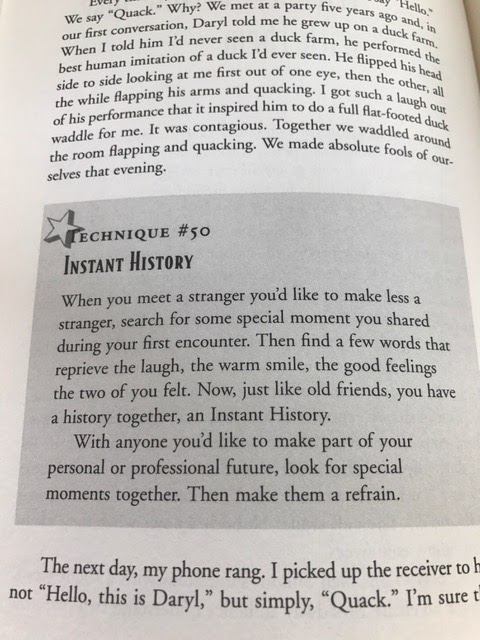
5.  Here is where you start panning for gold!  First, check the end of chapter 1 for a 'review' or 'summary' or 'wrap up'.  Some authors use this for each chapter, and it's so helpful for us as gold panners.  If so, simply jump to each one of these, and write anything down you feel you need.  Here's an example of a quick review from How to Talk to Anyone, by Leil Lowndes:


Since all of the gold had a grey background in this book, it was easy to spot. All the other writing was a longer hand version of this...and stories of when her friends tried this. Unnecessary! 

You may find a piece of information that you want more of in that summary.  If you do, just go back through the chapter quickly, looking for the terms that apply, and just take what you need.

If the chapters don't have the summaries, you'll have to work a little harder.  But all you have to do is rotate your pan in the water, sifting and scanning for information relative to you.  Most of the time there are bold letters, or headings that will help in your search.  

Always use the dog-eared Table of Contents to keep you guided throughout, and as a reference for what to find... and where.  

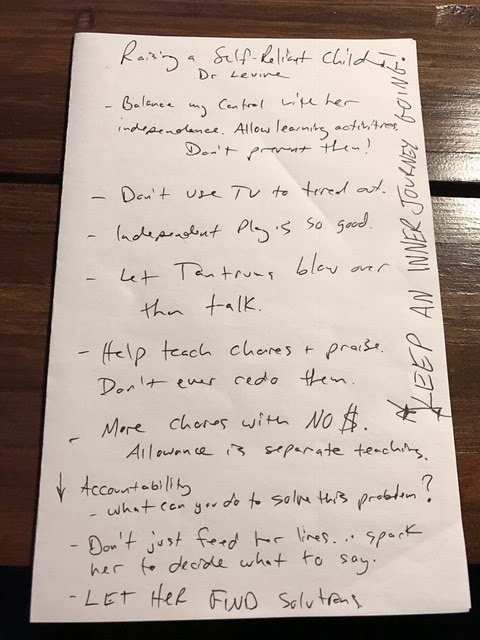
You may write down a lot.  You may just write down 2 bullets of information...2 nuggets of gold.  You may have a photographic memory and not have to write anything down.  It's up to you.  Since my own memory is more bronze than gold, I do have to write something down.  I also enjoy having a folder in my drawer where I keep my 'sheets of gold'.  I know that I can quickly go back and find what I wrote down...access the inspiring notes to keep me practicing a new habit...or find that author I liked to help me find that other book he or she wrote.  Here is an example of one of my sheets of gold (from the book Raising a Self-Reliant Child by Alanna Levine):


I simply write the title and author on top, and then some notes below.  My handwriting should tell you that I'm doing this fast.  Hopefully, I can read it when I go back to it!

Here's another one with less notes.  It's from the book 30 Lessons for Living: Tried and True Advice from the Wisest Americans, by Karl Pillemer:


That's it!  Again, this takes 10-15 minutes, and you can pan a book a day! You'll be rich before you know it.  Think of all of the great research you can access...the great authors and innovative thinkers...the people who have failed and then found the most effective ways to succeed...the parents who know what works.  You can use all of their blueprints.  It's very handy.  By the way...I've spent a lot of money on education up to this point.  I'm very happy I did, and I'll probably continue to do more.  However, all of this gold panning I've been doing...all of the 'acquisition of knowledge'...has been totally free, from my public library!   A guy I play basketball with told me, 'that works just as good...all the greatest minds in history are right there on the shelf.'  Nicely put right?  Thanks Matt!
This is your pass to free gold!


One last note...often I email the author, thanking them, and letting them know that their information was helpful.  Sometimes their email address is in the 'About the Author' section.  If not, some quick Googling can usually find it.  I think they deserve the gratitude.  I also see it as networking, and connecting with these folks I have a lot of respect for.  You can consider them mentors in absentia...and think of them as part of your own Circle of Elephants that I mentioned in another blog post.

I've been surprised at the emails I get in return.  Most of the time it's a secretary or publicist that writes me back, telling me they'll forward my message on.  Sometimes though, the author writes back, happy to hear from a reader.  And now you have a specialist in your contact list!  Last week, I was happily exchanging emails with Jack Welch, the former CEO of General Electric.  Someday, I might want to ask him a business question...and it's fun to know that he might actually respond!  I'm still waiting to hear from Warren Buffett.

Good luck in your journey finding and becoming gold!


Please 'follow by email' below if you enjoyed this piece.  Or click the 'follow' button if you're a fellow gmailer.  Thanks for your time!